
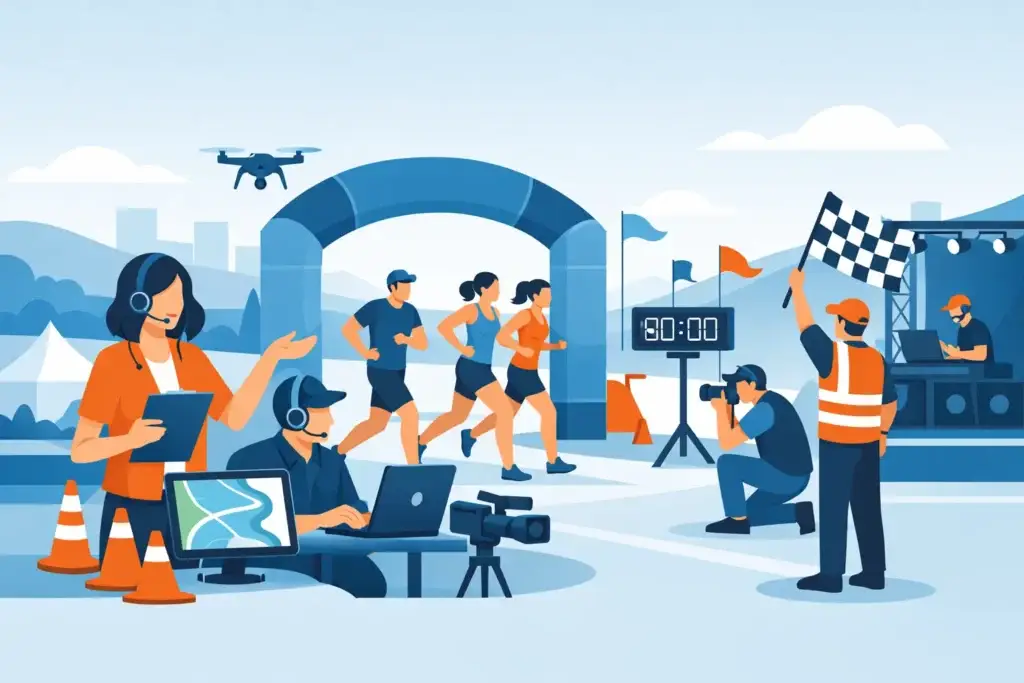
An event rarely falls short because the idea was weak. More often, it struggles because too many critical details were left to chance – permits, site flow, volunteer coordination, vendor timing, participant communication, and on-the-ground decision-making when conditions shift. That is where a race event production company earns its value. Not as an extra layer, but as the team that turns a race concept into an event people trust, enjoy, and want to return to.
For organizations planning a 5K, walk-run fundraiser, community road race, or larger endurance event, the pressure is real. Participants expect a polished experience. Sponsors expect visibility and organization. Municipal partners expect compliance and professionalism. Internal teams often expect to handle it all until the workload starts multiplying. At that point, race production stops being a simple checklist and becomes a live operational system.
Why organizations hire a race event production company
Most organizers do not need more ideas. They need structure, accountability, and experienced execution.
A event production company helps close the gap between vision and delivery. That includes early-stage planning, operational mapping, vendor coordination, site logistics, volunteer management, participant experience design, and race-day oversight. For some clients, that support starts with building a race from scratch. For others, it means stepping into an existing event that has outgrown internal capacity or needs a stronger operational backbone.
The advantage is not just convenience. It is risk reduction and quality control. When one partner is managing interdependent pieces, there is less room for confusion between stakeholders, fewer assumptions about who owns what, and faster response when something changes.
That matters because race events are dynamic by nature. A minor course adjustment can affect signage, staffing, aid station placement, police detail timing, and runner communication. A weather issue can alter load-in, registration plans, and start-line procedures within hours. Without experienced production leadership, those changes can create avoidable stress and visible breakdowns.
What an event production company actually manages
The scope depends on the event, but strong production support usually begins long before race day.
Event strategy and concept development
Some events start with a clear model and annual history. Others begin with a broad goal, such as community engagement, fundraising, brand visibility, or activating a public space. In those cases, production planning often starts with strategic questions. What type of race best fits the audience? What course experience supports the event’s purpose? How should the schedule, footprint, and participant touchpoints be structured?
This phase is often underestimated. If the foundational event design is weak, operations become harder later. A thoughtful production partner helps shape the event so that logistics, experience, and organizational goals support one another from the start.
Logistics, permitting, and coordination
This is where complexity tends to expand quickly. Race logistics can include venue coordination, municipal approvals, route planning, equipment needs, road closure support, emergency planning, staffing structures, and timeline development. Each workstream affects the others.
A capable production team creates order across those moving parts. That does not mean every event needs the same level of process. A local nonprofit 5K has different needs than a multi-site endurance weekend. But both require clear planning, defined responsibilities, and operational discipline.
The trade-off is usually between control and bandwidth. Some organizations want to remain deeply involved in each decision. Others want a partner to take ownership and drive the process. The right production model should match the client’s team capacity, approval structure, and event goals.
Vendor management and site operations
Vendors can make an event stronger or harder, depending on how well they are managed. Timing, placement, setup access, power needs, tear-down schedules, and communication protocols all need active oversight. On race day, even a strong vendor lineup can underperform without coordination.
That is why site operations matter so much. Someone has to own the full picture – what arrives when, where it goes, who is responsible, and how issues are escalated. This is one of the clearest differences between a race that feels organized and one that feels improvised.
Volunteer management
Many events depend on volunteers, but volunteer reliance does not remove the need for professional management. In reality, it increases it.
Volunteers need recruitment support, role clarity, training, scheduling, check-in systems, and on-site supervision. If they are unclear about assignments, participant experience suffers immediately. Registration lines slow down. Course marshaling becomes inconsistent. Water stops fall behind. Basic questions go unanswered.
A production partner helps turn volunteer enthusiasm into useful event support. That structure protects both the participant experience and the reputation of the organization behind the race.
Participant experience is part of operations
A common mistake is treating race operations and participant experience as separate priorities. They are not.
Participants notice when parking is confusing, signage is sparse, registration is backed up, start corrals feel disorganized, or finish-line flow creates congestion. They also notice when things work well. A smooth check-in process, intuitive site layout, clear announcements, well-placed course support, and a thoughtful finish experience all signal competence.
That has practical implications. Better participant experience supports retention, stronger word of mouth, and sponsor confidence. It also affects how an organization is perceived by community partners and municipal stakeholders.
A race event production company should be thinking beyond basic functionality. The goal is not simply to get people from the start line to the finish line. It is to create an experience that feels intentional, welcoming, and well-managed at every stage.
When internal teams hit their limit
Many organizations begin by managing races internally, often with committed staff who are already balancing marketing, community outreach, fundraising, and general operations. That approach can work for a time. But growth changes the equation.
Once registration increases, sponsor expectations rise, or operational demands become more layered, internal teams often find themselves spending too much time solving execution issues and too little time focusing on strategy and stakeholder relationships. That is usually the point where outside production support becomes less of a luxury and more of a practical business decision.
This is especially true for races that are being refreshed, repositioned, or rebuilt. A legacy event may need stronger logistics. A fundraising race may need a better participant journey to improve retention. A new branded event may need concept development and execution support from the ground up. Each scenario calls for slightly different expertise, but all benefit from experienced production leadership.
How to evaluate an event production company
Not every production partner works the same way, and the right fit depends on what your organization actually needs.
Experience matters, but relevance matters more. A company that understands public-facing events, stakeholder coordination, volunteer systems, and site operations will usually bring more value than one with a broad events background but limited race-specific discipline. You also want a team that can think strategically while managing details. Creative ideas are useful, but only when paired with executional control.
Look for clarity in process. How do they plan? How do they communicate? How do they handle contingency decisions? A strong partner should reduce ambiguity, not create more of it.
It also helps to assess whether the company can scale its role appropriately. Some clients need full-service support from concept to race-day management. Others need targeted help with logistics, operations, or event enhancement. Flexibility matters because overbuilding support can strain budgets, while underbuilding support can leave major gaps.
For organizations in New England managing complex public events, that balance is often where an experienced partner such as Calibrate Event Production can make a measurable difference – bringing both strategic guidance and on-site control to events that need to perform well under real conditions.
The best events feel easy because they were planned well
Participants should not see the complexity behind a race. They should see a clear path, a confident team, and an event that feels ready for them.
That level of execution is rarely accidental. It comes from disciplined planning, coordinated leadership, and a production partner who understands that race-day success is built long before the first runner arrives. If your event carries reputational value, stakeholder expectations, or community visibility, professional production is not about doing more for the sake of it. It is about doing the right things, at the right time, with the right level of control.
The strongest races leave people with one simple impression: this was well run. That is the standard worth building toward.