
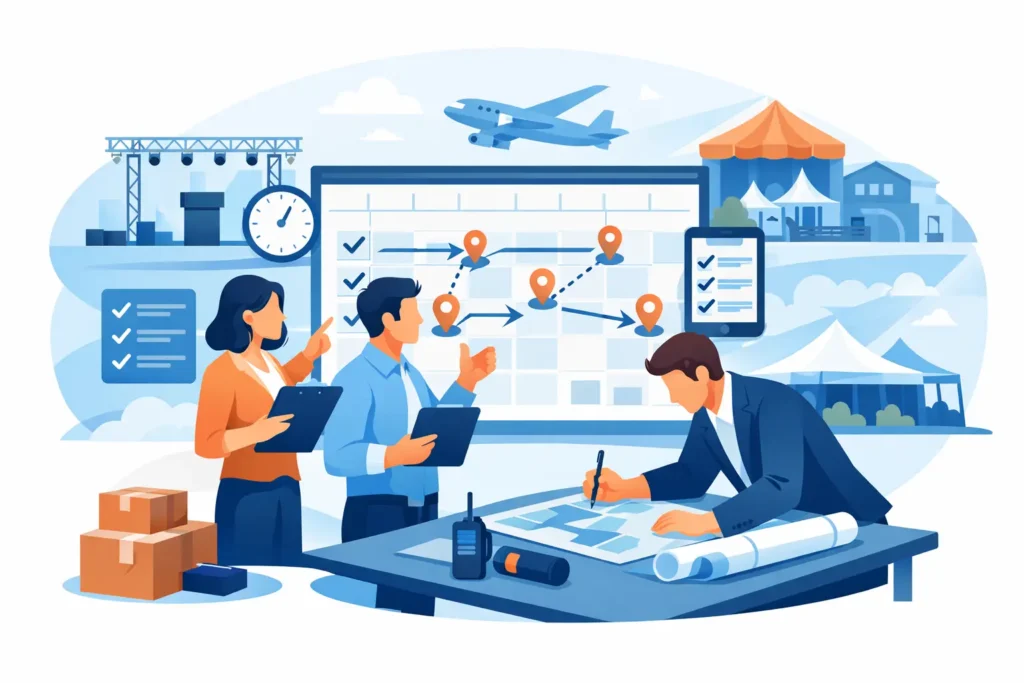
A run-of-show can look perfect on paper and still fail by 8:15 a.m. because the loading dock is backed up, the registration lead is fielding radio calls, and the power drop for the stage was approved but never confirmed on site. That is why event logistics planning matters. It is not the decorative layer of an event. It is the operating system that keeps the experience intact when timing tightens, vendors overlap, weather changes, or attendance outpaces the forecast.
For organizations managing public events, brand activations, races, festivals, fundraisers, and community programs, logistics is where strategy becomes real. It determines whether attendees move easily through the space, whether vendors know where to be and when, and whether your internal team can focus on guests instead of putting out fires. Good planning reduces friction. Great planning protects the event.
What event logistics planning actually covers
Event logistics planning is the coordination of all the practical systems required to deliver a live event successfully. That includes timelines, site flow, load-in and load-out, staffing plans, vendor coordination, permits, equipment placement, communications, contingency planning, transportation, and participant movement.
In other words, it is the work beneath the visible experience. Attendees may notice a polished check-in, short lines, clear signage, and an on-time program. They usually do not see the credentialing process, the site maps, the backup power plan, or the vendor sequencing that made those moments possible. That is normal. In many cases, the best logistics are nearly invisible.
What makes this discipline challenging is that no element stands alone. A small change to parking can affect shuttle timing. A sponsor activation can alter foot traffic around registration. A delayed tent installation can compress AV setup and force changes to the program schedule. Event logistics planning requires teams to think across dependencies, not just tasks.
Why event logistics planning fails when teams treat it as a checklist
Many events run into trouble because logistics gets reduced to a list of to-dos. Permits filed, vendor booked, site visit done, staffing assigned. Those tasks matter, but a completed checklist is not the same thing as an integrated plan.
The real question is whether each moving part has been coordinated in context. Does your site map reflect actual attendee behavior, not just ideal pathways? Does your volunteer plan account for breaks, no-shows, and escalation points? Is your program schedule compatible with your load-in window, sound checks, and public access restrictions?
This is where experienced event teams create separation. They do not just ask whether something has been handled. They ask whether it has been pressure-tested.
That distinction becomes even more important for events with multiple stakeholders. Municipal partners, sponsors, venues, public safety teams, nonprofit boards, and internal leadership often have different priorities. Without a single logistics lead or production structure, decisions get made in parallel, and the event absorbs the conflict later.
The planning horizon matters more than most teams expect
Strong logistics planning starts earlier than many organizations prefer. Not because every detail must be locked months ahead, but because key operational decisions shape everything that follows.
Site selection is a good example. A venue may look right in terms of size, cost, or aesthetics, yet create major complications around parking, access, rigging, power, staging, or public safety. Those issues are manageable if identified early. They are expensive and disruptive when discovered late.
The same is true for event format. If you are building a race, street festival, downtown activation, or multi-zone experience, the operational footprint often grows faster than expected. Entry points, route control, participant services, traffic patterns, and neighborhood impact all need to be planned together. If the concept is ambitious but the infrastructure is not, the attendee experience suffers.
Early planning also gives teams room to make better trade-offs. Sometimes the right answer is not adding more equipment or more staff. It may be simplifying the site plan, tightening the program, or reducing unnecessary transitions. Good logistics is not about complexity for its own sake. It is about supporting the experience with the right level of operational control.
The event experience is shaped by logistics
Clients often think of logistics and experience as separate conversations. In practice, they are tightly connected.
Arrival sets the tone. If parking is confusing, wayfinding is weak, or check-in creates a bottleneck, attendees feel it immediately. The same goes for restrooms, food access, crowd flow, and clear transitions between activities. These are logistical decisions, but they influence how guests describe the event afterward.
For participant-facing events, logistics also affects confidence. A runner wants to know where to park, where to line up, how bag check works, and what happens if conditions change. A festival attendee wants obvious entrances, visible staff, and intuitive movement through the grounds. A sponsor wants setup clarity, power reliability, and a realistic understanding of foot traffic. Each of those expectations lives inside the logistics plan.
This is one reason experienced production teams spend time walking the event from the attendee perspective, not just from the organizer perspective. What looks efficient on a spreadsheet may feel confusing on site. The best plans account for both.
Where to focus first in event logistics planning
If an organization is refining its planning process, the first priority is visibility. Everyone involved should understand who owns decisions, how updates are shared, and what the current version of the plan actually is.
From there, focus on the operational categories that create the most downstream impact. Site operations is usually near the top of the list because it affects vendors, staff movement, attendee flow, safety, and timing all at once. Vendor management comes next, especially when multiple suppliers are working on overlapping schedules with different technical requirements.
Communications planning is another area teams underestimate. Radios, call trees, escalation paths, and point-person assignments sound basic until something shifts on event day. When there is no clear communication structure, teams lose time deciding who should respond instead of solving the problem.
Contingency planning deserves the same level of discipline. Weather is the obvious example, but not the only one. Staffing gaps, vendor delays, road access changes, medical incidents, and equipment failure are all common enough to plan for. The goal is not to predict every possible issue. It is to know how decisions will be made when conditions change.
What a strong logistics partner changes
Organizations often bring in outside support because the event is large, visible, or time-sensitive. Just as often, they do it because internal teams are stretched. Marketing leads should not be managing dock schedules. Executive directors should not be troubleshooting volunteer deployment from a parking lot. Operations managers should not have to coordinate every vendor call while also representing the organization on site.
A strong logistics partner creates structure before the event and clarity during it. That means building workable timelines, aligning stakeholders, managing vendors, identifying weak points early, and translating the vision into an executable operating plan. It also means having enough production discipline on site to adjust without creating confusion.
For complex public-facing events, that level of support often changes the outcome more than any single creative element. Attendees may remember the atmosphere, the program, or the brand presence. What they respond to, even if they do not name it directly, is whether the event felt organized and well run.
That is especially true for organizations in markets like New England, where weather variability, municipal coordination, and venue constraints can shape the event as much as the concept does. A polished plan has to work under real conditions, not just ideal ones.
The goal is not perfection. It is control.
No live event unfolds exactly as planned. A speaker arrives late. A vendor truck gets held up. Attendance spikes in one area and dips in another. That is normal. The measure of strong event logistics planning is not whether the day stays frozen to the original plan. It is whether the team can adapt without losing quality, safety, or confidence.
That is why the best event plans are specific without being rigid. They establish responsibilities, timing, and contingency paths clearly enough that the team can respond fast when the unexpected happens. They reduce guesswork. They protect the attendee experience. And they give organizers room to lead the event instead of chasing it.
When logistics is handled well, the event feels steady. Guests know where to go. Partners know what to expect. Staff knows what to do. That kind of control is not accidental. It is built through planning that is disciplined, realistic, and tied to the experience you want people to remember.