
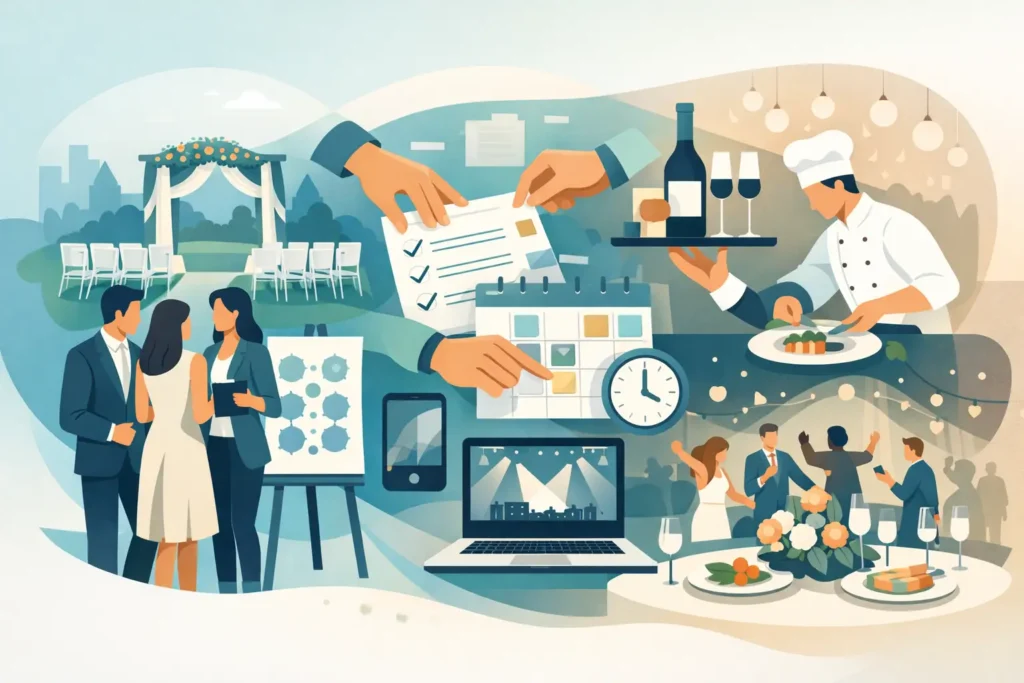
A registration line that backs up for 20 minutes can overshadow months of good planning. So can unclear vendor timelines, volunteer confusion, weak site flow, or a program that feels flat once guests arrive. That is why many organizations turn to a full service event planning company – not just for help with tasks, but for control, clarity, and a better attendee experience from start to finish.
For teams managing races, festivals, community events, nonprofit gatherings, brand activations, or public-facing programs, the challenge usually is not having one big problem. It is having fifty moving parts that all affect each other. Venue decisions affect load-in. Load-in affects staffing. Staffing affects attendee flow. Attendee flow affects satisfaction, safety, and whether the event feels polished or improvised. A capable planning partner sees those connections early and manages them before they become expensive on event day.
What a full service event planning company actually covers
A full service event planning company is responsible for more than booking vendors and building a run of show. The real value is end-to-end management. That includes shaping the event concept, building the operational plan, coordinating vendors and stakeholders, managing budgets and schedules, supporting staffing and volunteers, and overseeing execution on site.
At the front end, that may mean helping define what the event needs to accomplish. For a brand, the goal may be audience engagement and visibility. For a municipality, it may be public participation and smooth civic coordination. For a nonprofit, it may be fundraising, mission visibility, and a guest experience that reflects the organization well. Good planning starts by aligning the event format with those goals, rather than choosing activations or production elements in isolation.
From there, the work becomes more operational. Timelines, site plans, permitting needs, vendor scopes, equipment requirements, registration flow, signage, transportation, staffing structure, contingency planning, and communication systems all need to be built into one workable framework. This is where many internal teams start to feel pressure. Even highly capable marketing or operations departments may not have the dedicated bandwidth to manage event logistics at production level.
Why organizations hire a full service event planning company
The most common reason is not lack of ideas. It is lack of capacity.
Internal teams are often balancing an event alongside full-time responsibilities. That can work for smaller gatherings, but once attendance grows, stakeholder groups multiply, or public-facing logistics become more complex, event planning stops being a side project. It becomes a specialized discipline.
A full service event planning company brings structure to that complexity. Instead of chasing details reactively, the planning process becomes proactive. Roles are defined. Timelines are realistic. Vendors know what is expected. Site operations are mapped in advance. Decision-makers get visibility without having to manage every moving part themselves.
There is also a quality issue. Events are judged by how they feel to participants, not by how hard the team worked behind the scenes. Guests notice whether arrival is easy, transitions make sense, signage is clear, and the environment feels intentional. They may never see the production plan, but they absolutely experience the results of it.
That matters for public trust, sponsor value, donor confidence, and brand perception. If an event is meant to strengthen relationships or create momentum, execution has to support that objective.
Strategy and execution both matter
One of the biggest distinctions between a limited coordinator and a true service partner is the ability to work at both the strategic and operational levels.
Some events need to be created from scratch. Others need to be refreshed because they have become predictable, difficult to manage, or misaligned with current goals. In both cases, planning should address more than logistics. It should also address experience design.
That includes questions like: What should participants feel at key moments? Where are traffic bottlenecks likely to happen? What does sponsor visibility look like in practice? How do volunteers support, rather than slow down, the guest experience? What parts of the event are memorable, and what parts are simply functional?
A strong event partner does not treat those as separate conversations. Creative decisions and operational decisions have to support each other. A great idea that cannot be staffed, staged, or safely executed is not a great idea. On the other hand, a technically efficient event that feels generic may meet the checklist without creating real impact.
The best work happens when planning, design, and production are connected from the beginning.
Where full-service support makes the biggest difference
Complex live events usually break down in predictable places. Vendor management is one. When multiple vendors are involved, someone needs to own communication, deadlines, scope alignment, delivery timing, and on-site coordination. Without that oversight, even strong vendors can work at cross-purposes.
Volunteer management is another pressure point, especially for nonprofits, races, and community events. Volunteers can be a major asset, but only when they are recruited, assigned, briefed, and supported well. If they arrive without clear responsibilities or supervision, the event team often ends up solving avoidable problems in real time.
Site operations is another area where experience matters. Guest entry, parking, check-in, stage transitions, equipment placement, participant movement, and emergency procedures all shape whether an event feels orderly. These details are easy to underestimate because each one seems small on its own. Together, they define the event day experience.
In markets across New England, that operational rigor also has to account for local realities such as weather shifts, outdoor venue constraints, municipal coordination, and seasonal scheduling pressure. Experience in live production helps teams plan for those variables without overcomplicating the event.
When full service is the right fit – and when it may not be
Not every event needs a fully integrated planning partner.
If an organization is hosting a small internal gathering with a simple format, a limited-scope coordinator or in-house team may be enough. Full service becomes more valuable when the event has multiple vendors, public attendance, sponsorship elements, complex logistics, volunteer teams, safety considerations, or high visibility for the host organization.
It is also the right fit when leadership wants a stronger event but does not want to build an internal production department to get there. That is often the real decision. Hiring a full service event planning company is not just outsourcing labor. It is gaining a planning framework, production discipline, and an experienced team that knows how to connect strategy to execution.
For some organizations, the need is temporary. They may be launching a new event, relaunching an established one, or navigating a year with unusual complexity. For others, outside event leadership becomes part of their long-term model because it gives them consistency without adding permanent overhead.
How to evaluate a planning partner
The right partner should be able to explain not only what they do, but how they think.
Look for a team that can speak clearly about process, decision-making, and on-site management. Ask how they approach event creation, not just event coordination. Ask how they handle changing conditions, cross-functional communication, and participant experience. If the answers stay at a surface level, the service probably does too.
It also helps to look for balance. You want a partner with enough creative perspective to improve the event and enough operational discipline to deliver it reliably. Some firms lean heavily toward aesthetics but struggle with logistics. Others are technically competent but do little to strengthen the event experience. The best full-service support combines both.
This is where a company like Calibrate Event Production stands out. The value is not simply in covering a checklist of services. It is in bringing concept development, logistics, vendor oversight, volunteer management, and site operations into one accountable plan.
A good partner should also reduce friction for your internal team. If hiring outside support creates more meetings, more confusion, or more handoffs without improving control, something is off. The relationship should make decisions easier, responsibilities clearer, and outcomes stronger.
The real result is confidence
When organizations hire experienced event support, they are usually trying to protect more than a date on the calendar. They are protecting reputation, stakeholder trust, sponsor value, and the experience people will remember afterward.
That is why the right planning company does more than keep the event on schedule. It helps the host organization show up at its best. The event feels organized, participant-centered, and professionally run because the work behind it was thoughtful, disciplined, and complete.
If your team is carrying too much event complexity on its own, that is usually the signal. The goal is not to hand off responsibility and hope for the best. It is to bring in the kind of expertise that makes the entire event stronger before anyone ever arrives on site.