
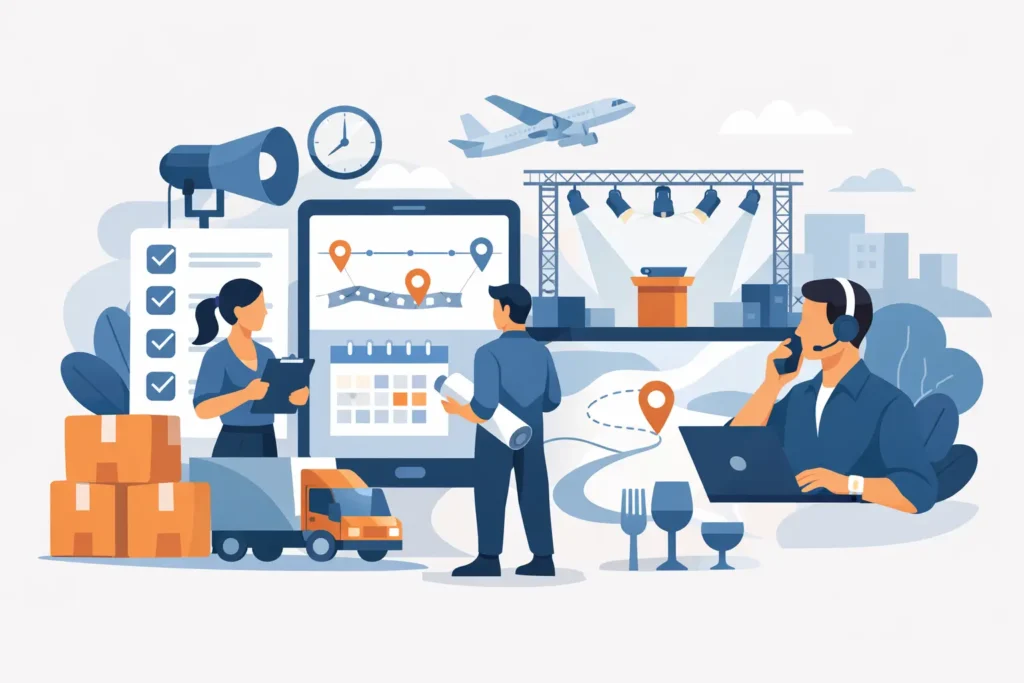
A run-of-show can look airtight on paper and still fall apart at 6:15 a.m. when the delivery truck is late, volunteer check-in backs up, and the power drop is set on the wrong side of the venue. That gap between plan and performance is where event logistics planning services prove their value. They turn a promising event concept into an operation that can hold up under real-world pressure.
For organizations running races, festivals, community events, brand activations, fundraisers, and public-facing programs, logistics are rarely a side task. They are the work. Creative matters, audience experience matters, sponsorship matters, but none of it lands if the site is not ready, the vendors are not aligned, or attendees hit friction at every turn. Strong logistics protect the event, the brand behind it, and the people showing up for it.
What event logistics planning services actually include
At a basic level, event logistics planning services coordinate the moving parts required to produce a live event safely, efficiently, and on schedule. In practice, that scope is broader than many teams expect.
Logistics starts with translating the event vision into a working plan. That usually includes site layout, load-in and load-out sequencing, vendor coordination, equipment scheduling, staffing plans, communication protocols, permitting support, participant flow, and contingency planning. It also includes the less visible decisions that shape the attendee experience, such as where check-in should happen, how lines will move, when waste gets cleared, and what happens if weather changes the schedule.
For some events, logistics support is mostly operational. A client already has the concept, brand direction, and programming, but needs a team that can organize vendors, timelines, and site execution. For others, logistics is integrated with event design from the beginning. That matters because operational decisions affect the experience. A stage placement choice can improve energy or create bottlenecks. A registration setup can feel welcoming or frustrating. Good planning accounts for both.
Why logistics often decides whether an event feels polished
Attendees rarely compliment logistics directly. They notice when parking is easy, signage makes sense, sessions start on time, and staff know where to send them. They also notice when those things go wrong.
That is why experienced planners look beyond the visible program and focus on the systems supporting it. A polished event is usually the result of disciplined coordination behind the scenes. Timelines have been tested. Vendor responsibilities are clear. Site maps reflect how people will actually move. There is a chain of command, and there are backup plans.
This is especially true for events with multiple stakeholders. A municipality may be balancing public safety, neighborhood impact, and sponsor expectations. A nonprofit may be managing volunteers, donors, attendees, and a lean internal staff. A brand team may need a public-facing experience that looks effortless while meeting tight internal deadlines. In each case, logistics is what keeps competing priorities from turning into confusion on site.
The core areas a logistics team manages
The most effective logistics partners do more than create checklists. They build an operating structure for the event.
Planning usually begins with timeline development. That includes milestone deadlines in the months leading up to the event and a detailed production schedule for event week. Without that structure, teams tend to make decisions too late, which limits options and raises costs.
Vendor management is another major area. Rentals, staging, AV, tents, sanitation, security, medical support, transportation, catering, and waste services all have their own requirements and dependencies. Someone has to coordinate arrival times, technical needs, insurance documentation, site access, and points of contact. When no one owns that process centrally, problems multiply.
Staffing and volunteer planning also sit squarely within logistics. It is not enough to recruit people. They need schedules, training, reporting lines, escalation procedures, meal breaks, and location-specific assignments. A well-staffed event can still feel disorganized if the team does not know where to be or what authority they have.
Then there is site operations. This covers the practical conditions that affect both safety and experience: load zones, credentialing, traffic flow, storage, signage placement, back-of-house setup, power access, sanitation, and accessibility. Site operations is where many events either gain confidence or lose it.
When to bring in event logistics planning services
Some organizations wait until the event is too complex for internal staff to manage comfortably. By then, the best a partner can often do is stabilize the plan. That can still help, but earlier involvement usually creates better outcomes.
If your event has multiple vendors, public attendance, road closures, permitting, volunteer teams, sponsor activations, or a detailed site build, logistics support should be considered early. The same goes for events that are growing quickly, changing format, entering a new location, or recovering from past operational issues.
There is also a capacity question. Even a highly capable internal team may not have the bandwidth to manage every planning thread while also handling internal approvals, marketing, fundraising, or stakeholder communication. In those cases, outsourcing logistics is less about expertise alone and more about preserving focus across the organization.
What to look for in a logistics partner
Not all event support is built the same. Some firms are strong on creative direction but lighter on field execution. Others can manage site operations well but are less effective in early planning. The right fit depends on the event.
For most organizations, the best logistics partner is one that can think strategically and execute practically. They should be able to ask the right questions early, identify pressure points before they become emergencies, and keep communication clear across vendors and stakeholders.
Experience with comparable event types matters. A road race, a downtown festival, and a donor event may all be called events, but the logistics profile is very different. So is the operating pace. A partner with relevant experience can anticipate the issues that first-time teams miss.
You should also look for discipline in process. That means clear timelines, documented responsibilities, regular planning communication, and a realistic approach to budget and scope. Promises are easy in the pitch stage. Operational control is what matters when the schedule tightens.
The trade-offs organizations should understand
There is no universal event plan, and logistics decisions always involve trade-offs. A more ambitious footprint may improve visibility but increase staffing and security costs. More programming can increase attendee value but put pressure on turnover time and technical support. A venue with strong aesthetics may create difficult access for vendors or guests.
This is where experienced guidance matters. Good logistics planning does not just say yes to ideas. It helps clients weigh impact against complexity. Sometimes the right move is expanding the experience. Sometimes it is simplifying the plan so the event performs better.
Budget is part of that conversation too. Event logistics planning services are an investment, but poor coordination has its own costs: overtime, rushed rentals, preventable vendor errors, weak attendee flow, sponsor disappointment, and team burnout. The question is not just what support costs. It is what unmanaged complexity will cost if no one is truly leading operations.
Why regional knowledge can matter
For events across New England, local operating knowledge can make planning more efficient. Venue norms, municipal permitting processes, weather patterns, vendor networks, and seasonal constraints vary widely even across neighboring states. A team that understands those realities can move faster and flag issues earlier.
That does not mean local knowledge replaces production skill. It means the strongest partners combine both. Calibrate Event Production, for example, works at that intersection of strategic planning and on-the-ground execution, which is often what complex public and participant-focused events require.
Event logistics planning services are really about risk control and experience
The clearest sign of strong logistics is not that everything goes perfectly. Live events are too dynamic for that. The real sign is that issues are handled without disrupting the audience, the client, or the broader event goals.
That takes preparation, structure, and judgment. It takes someone seeing the full picture while managing the smallest details. And it takes a planning approach that treats operations not as a back-office function, but as the foundation of the event itself.
If your team is carrying too many moving parts, or your event has outgrown a patchwork approach, the right logistics support can change more than the day-of execution. It can give everyone involved the confidence to build something bigger, better organized, and more memorable.