
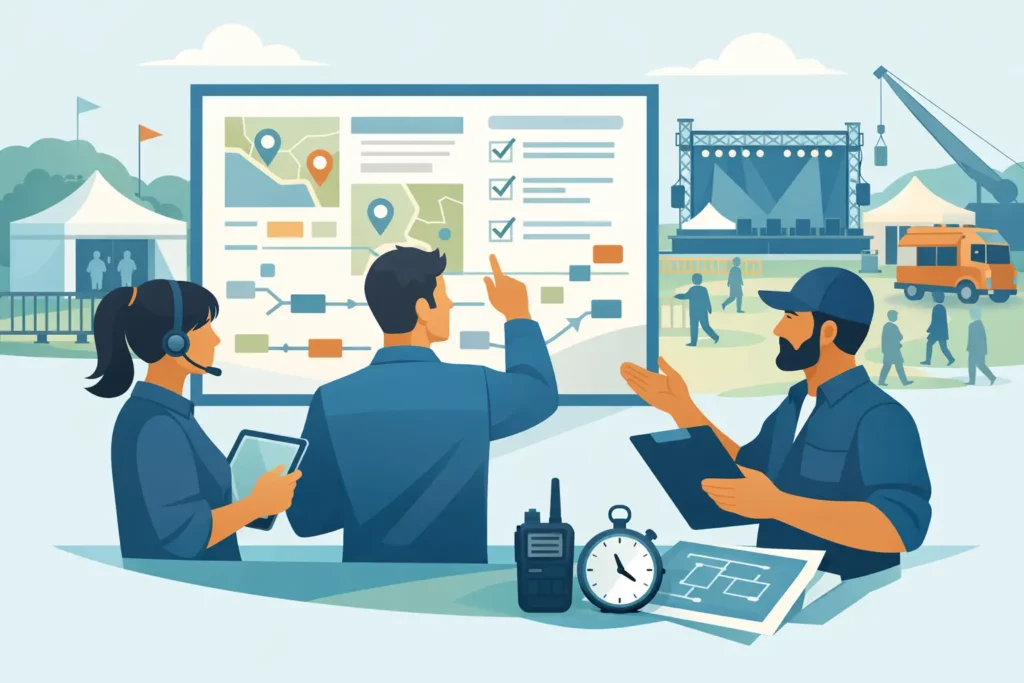
The event rarely goes off track because of one major failure. More often, it slips through a series of small misses – a load-in route that backs up, a power drop placed too far from show control, a volunteer team that gets a briefing too late, a registration line with no shade or overflow plan. Event site operations planning is what prevents those misses from stacking up into attendee frustration, sponsor concerns, or staff burnout.
For organizations running road races, festivals, civic activations, brand events, and public gatherings, site operations is where strategy meets reality. A good concept can get people interested. A well-run site is what makes the experience feel credible, safe, and worth repeating. That matters whether you are launching a new event, rebuilding an existing one, or trying to raise the standard of an established program.
What event site operations planning actually covers
At its core, event site operations planning is the discipline of turning an event footprint into a functioning environment. It connects the site map to the schedule, the staffing plan to the attendee flow, and the vendor list to the physical conditions on the ground. It is not just logistics in the abstract. It is the practical work of deciding how people, equipment, vehicles, services, and decisions move through a site without creating avoidable conflict.
That includes obvious elements like entrances, exits, restrooms, staging, power, signage, waste removal, and emergency access. It also includes less visible decisions that tend to determine whether the day feels organized or strained – where staff check in, how radios are distributed, when vendors can restock, what happens if weather shifts, and who has authority to make time-sensitive calls.
For complex events, these details cannot be left to a last-minute walkthrough. By the time the site is live, every oversight becomes more expensive to fix.
Why event site operations planning matters early
Many event teams treat site operations as a downstream task. They confirm the concept, secure key partners, build marketing, and then move into the physical site plan once the event date gets closer. That approach creates pressure in the wrong place.
Operations should inform planning much earlier because the site affects almost every major event decision. Capacity influences programming. Utility access affects vendor placement. Emergency routes limit how activation zones can be built. Noise spill can shape where entertainment belongs. If those realities are discovered too late, teams end up redesigning around constraints instead of planning with them in mind.
This is especially true for public-facing events in dense downtowns, parks, campus settings, or multi-use venues across New England, where weather, permitting, traffic patterns, and shared infrastructure can change the operating picture quickly. An attractive site is not always an efficient one. A familiar site is not always a forgiving one.
Start with how the event needs to function
A site plan should not begin with where things fit. It should begin with how the event needs to function over time.
That means asking operational questions before drawing a footprint. How do attendees arrive, queue, enter, and orient themselves? Where do sponsors need visibility without interrupting circulation? When does each vendor load in, and can their vehicles move without crossing attendee paths? Where will staff solve problems without becoming a visible bottleneck? How long does teardown really take once the crowd clears?
When teams start with function, the site becomes easier to manage because it is designed around actual use. When they start with static placement alone, they often create layouts that look clean on paper but fail under real event conditions.
This is one of the most common trade-offs in site design. A tightly packed footprint may feel energetic and efficient, but it can also create congestion, poor sightlines, and limited emergency flexibility. A more spread-out footprint may improve comfort and circulation, but it can increase staffing demands and dilute activity zones. The right answer depends on event goals, audience behavior, and the resources available to support the plan.
The strongest plans account for movement, not just space
Operations teams know that movement is usually the real challenge. People move unpredictably. Vehicles arrive late. Vendors need access at inconvenient times. Weather changes how attendees use the site. If the plan only accounts for where things are located, it will miss how the site behaves.
That is why circulation deserves more attention than it often gets. Entry and exit points should match expected arrival patterns, not just physical availability. Queuing areas should avoid blocking key pathways. High-demand areas like registration, concessions, merch, hydration, or packet pickup need room for both service and overflow. ADA access should be integrated from the start, not layered in as a compliance item.
The same is true behind the scenes. Back-of-house routes, storage areas, crew staging, green rooms, medical access, and waste collection should reduce cross-traffic rather than compete with front-of-house operations. When support functions are forced into attendee space, the event starts to feel improvised.
Staffing plans should reflect the site you built
One operational mistake shows up again and again: teams create a site layout and then assign staff around it afterward. That often leads to under-covered transitions, duplicated roles, and supervisors who cannot actually see or reach the areas they are responsible for.
A stronger approach is to build staffing into the site planning process. Every zone should have a purpose, a lead, a communication path, and a defined escalation process. If an entrance backs up, who responds first? If a vendor loses power, who assesses whether it is a facilities issue, an equipment issue, or a broader distribution problem? If weather forces a timing adjustment, who updates the relevant teams and how quickly can that instruction travel?
Volunteers also need more operational support than many organizations expect. They can be excellent ambassadors and point-of-contact staff, but only if they are placed well, briefed clearly, and backed by paid leads or experienced supervisors. A volunteer-heavy model can reduce cost, but it also increases the need for structure. That is a worthwhile trade-off only when the management plan is strong enough to support it.
Vendor coordination is part of site control
Vendors do not operate independently once they arrive on site. Their needs affect power, access, timing, noise, sanitation, and overall event flow. That is why vendor management belongs inside event site operations planning rather than sitting beside it.
Each vendor should know more than their arrival time and booth location. They should know where to unload, where to park, what utilities are actually available, when service begins, what cleanup standards apply, and who to contact if something changes. Ambiguity at load-in creates preventable delays, and those delays ripple across the site.
This matters even more when events involve food service, technical production, course infrastructure, temporary structures, or municipal partners. One late or misdirected vendor can affect multiple dependencies. Good operations planning reduces those chain reactions by clarifying sequence, access, and accountability well before event day.
Real-time decision making should be planned in advance
Even the best-run event will require adjustments. A forecast shifts. Attendance exceeds projections. A road closure runs long. A speaker arrives late. What separates a controlled event from a chaotic one is not whether problems appear. It is whether the team has a decision structure ready when they do.
That structure should define who monitors what, how information is shared, and who can authorize operational changes. In practice, that may include command positions, zone leads, radio protocols, incident reporting, and timing thresholds for weather or safety responses. It should also include communication plans for staff, vendors, and attendees.
There is no single model that fits every event. A 5K with a festival finish needs a different command setup than a downtown arts event or a multi-activity community day. But every event benefits from clarity. People work better when they know the chain of command, the escalation path, and the difference between an issue they can solve and one they need to report.
After-action review is part of planning, not an extra
Strong site operations improve over time because teams treat each event as a source of operational data. Where did lines form earlier than expected? Which staff posts were underused? Which vendors needed more support? What part of the footprint created confusion? Those answers should shape the next site plan.
That matters for annual events, but it also matters for one-time activations. Organizations that document lessons clearly build stronger internal knowledge, make better budget decisions, and reduce risk the next time they produce a live experience. Experienced partners like Calibrate Event Production often add value here because they can see patterns across event types and apply those lessons before the same issues repeat.
A well-run site does not happen because the team worked hard on event day. It happens because the operating plan matched the realities of the site, the audience, and the event’s ambitions. When that alignment is in place, attendees may never notice the mechanics behind it – and that is usually the clearest sign the work was done right.
If your event needs to feel polished under pressure, start by asking a simple question: does your site plan show where things go, or does it show how the day will actually work?