
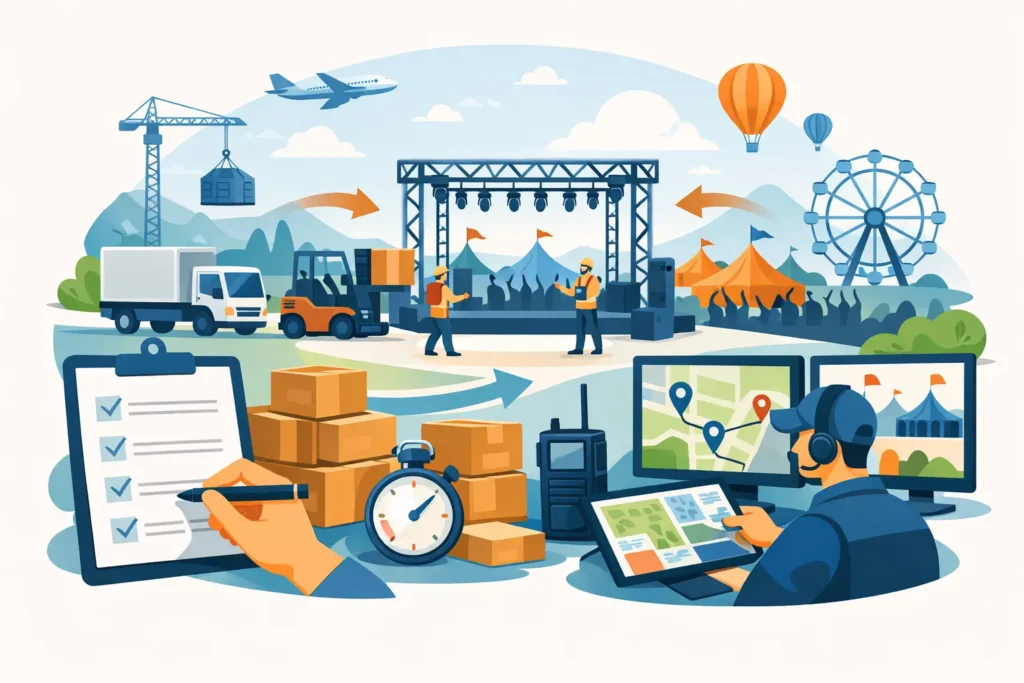
A festival schedule rarely falls apart because of one big mistake. More often, it slips because ten small decisions were made too late, by the wrong person, or without a full picture of the site. That is why festival logistics management matters so much. It is the discipline that turns a strong idea into an event people can actually attend, enjoy, and trust.
For organizers, municipalities, brands, and nonprofits, logistics is not the background work. It is the operating system. If load-in routes conflict with guest entry, if power is undersized, if volunteer check-in is vague, or if the rain plan lives only in someone’s inbox, the attendee experience feels the strain immediately. Good logistics protects the event vision. Great logistics makes that vision feel effortless to the public, even when the backend is anything but simple.
What festival logistics management really covers
Festival logistics management is broader than transportation, staffing charts, or vendor communication on their own. It is the coordinated planning of site operations, schedules, equipment, staffing, compliance, vendor flow, crowd movement, and contingency response. In practical terms, it means every moving part has an owner, a timeline, a location, and a backup plan.
That scope is exactly why many organizations underestimate it early on. A festival can look manageable when reviewed as separate tasks. Booking talent, confirming food vendors, arranging fencing, securing permits, and building a run-of-show can each seem reasonable in isolation. The challenge appears when all of those decisions start affecting each other. The placement of a stage changes sound bleed, which affects sponsor activation zones, which affects crowd flow, which affects barricade needs, staffing levels, and emergency access.
This is where experienced production planning earns its value. The work is not just to complete tasks. It is to understand dependency. When one operational choice shifts, what else moves with it?
Strong festival logistics management starts before the site map
Many teams begin logistics after the event concept is approved. In reality, the logistics conversation should shape the concept itself. Ambition is useful, but only when it is matched to site conditions, budget, staffing capacity, and audience behavior.
For example, adding a second entertainment area may improve programming variety. It may also increase generator needs, require more security posts, lengthen cable runs, complicate ADA routing, and create schedule overlap that disperses your crowd in the wrong places. The question is not whether a feature sounds attractive. The question is whether it can be supported well.
Early planning should answer a few foundational points. What is the actual attendee journey from arrival to departure? Where are the pressure points on site? Which elements are essential to the experience, and which are optional if conditions change? What approvals will dictate timing? These questions keep logistics tied to outcomes instead of becoming a reactive cleanup effort later.
The site plan is an operations document
A site map should do more than show where things go. It should explain how the event works.
The strongest plans account for public circulation, production access, emergency routes, vendor arrival patterns, waste removal, queueing, hydration points, restrooms, and visibility lines. They also consider what the site feels like at different times of day. A festival that works at 9:00 a.m. may bottleneck by 1:00 p.m. once food lines build, heat pushes guests toward shade, and family traffic settles into slower movement patterns.
This is one area where trade-offs matter. A dense site can create energy and drive engagement between zones. It can also create friction if guests feel crowded or if service vehicles have limited access. A more spread-out layout may improve comfort and safety, but it can reduce momentum if distances are too long. There is no universal best answer. The right layout depends on programming style, audience profile, and the level of operational control available on the ground.
Vendor coordination is often where risk hides
Festival organizers usually think about vendors in terms of contracts and arrival times. That is necessary, but not sufficient. Every vendor has operating needs that affect the broader system. Food and beverage partners may need water access, grease disposal, refrigeration support, lighting, fire extinguisher compliance, and precise load-in windows. Exhibitors may need power drops, Wi-Fi expectations, and defined vehicle removal deadlines. Production vendors need room to work safely before the public arrives.
Problems tend to surface when expectations are assumed rather than documented. If one food vendor brings a larger trailer than expected, it can disrupt spacing and egress. If a sponsor activation arrives with an unapproved footprint, it can interfere with nearby programming. If vendor credentials are unclear, staff lose time resolving issues at the gate instead of managing operations.
The fix is not more paperwork for its own sake. It is clear advance communication paired with a real enforcement plan. Confirm dimensions, utilities, arrival sequencing, contacts, and compliance standards before event week. Then make sure someone on site has authority to solve issues in real time.
Staffing, volunteers, and chain of command
A festival can have a strong concept, a well-built site, and reliable vendors, and still struggle if staffing is loosely structured. People need more than assignments. They need a chain of command, escalation paths, and enough context to make good decisions under pressure.
That applies to paid crew, temporary event staff, and volunteers alike. Volunteers are often the public face of a festival, especially at check-in, wayfinding, and community engagement points. If they are under-briefed, the guest experience suffers quickly. If they are over-assigned, attrition rises as the day progresses.
The most effective staffing plans are realistic about workload. They do not assume every post can be filled perfectly or that everyone will arrive equally prepared. They build in floaters, shift coverage, radio protocols, and briefing materials that are actually usable in the field. They also define who makes final calls when weather changes, lines grow, or a program element needs to be moved.
Confidence on event day comes from clarity, not volume. A concise operations brief, a clean contact structure, and a disciplined team lead system will outperform a large but loosely managed staffing roster every time.
Timing is everything, and timing is fragile
Festival timelines usually look solid until the first delay hits. A truck arrives late. A permit inspection runs long. A stage check extends by twenty minutes. Suddenly, three downstream tasks are affected.
That is why production schedules need margin. Not excessive padding, but deliberate space around critical transitions like site access, power-up, health inspections, talent arrival, and public opening. Overly optimistic schedules create artificial pressure. That pressure leads teams to skip checks, compress setup, or make rushed decisions that create larger problems later.
A reliable timeline also separates public-facing schedule from operational schedule. Attendees need simple, confident information. The production team needs a more detailed run-of-show that tracks dependencies, decision points, and ownership. Those are not the same document, and treating them as one usually creates confusion.
Weather, safety, and contingency planning
No festival plan is complete without practical contingency planning. Weather is the most obvious variable, especially for outdoor events in the Northeast, but it is not the only one. Power issues, medical incidents, traffic backups, staffing shortages, and vendor no-shows all deserve attention.
The key is specificity. A contingency plan should not say “move indoors if needed” unless the indoor option has been measured, staffed, approved, and communicated. It should not say “pause programming for weather” unless there is a defined threshold, a decision-maker, a messaging process, and a method to restart safely.
There is also a business reality here. Not every event can afford the same level of redundancy. Smaller festivals may need to prioritize the highest-impact risk areas first. That is reasonable. The goal is not to plan for every imaginable scenario. The goal is to reduce preventable failure and improve response time when conditions change.
Why experienced oversight changes the outcome
Festival logistics management works best when one team is looking across the whole picture. Without that oversight, each vendor or department may perform well within its own lane while the overall event still feels disjointed.
That is often the gap organizations run into when internal teams are stretched. Marketing may own audience growth, operations may manage permits, community teams may coordinate partners, and volunteers may support execution. Everyone is contributing, but no one is fully integrating. An experienced event production partner closes that gap by aligning planning, communication, and site operations under one operational framework.
For complex public events across New England and beyond, that kind of structure can be the difference between an event that simply happens and one that holds together under real-world pressure. Calibrate Event Production approaches this work with that exact mindset – not just checking boxes, but building systems that support the experience from first arrival to final load-out.
A well-run festival does not feel complicated to the audience. It feels easy, welcoming, and worth returning to. That result is rarely accidental. It comes from logistics that were taken seriously early, managed carefully throughout, and led by people who know how to keep moving parts working together when the stakes are real.
If your festival is growing, changing, or carrying more visibility than it used to, logistics is the place to get sharper before anything else does.