
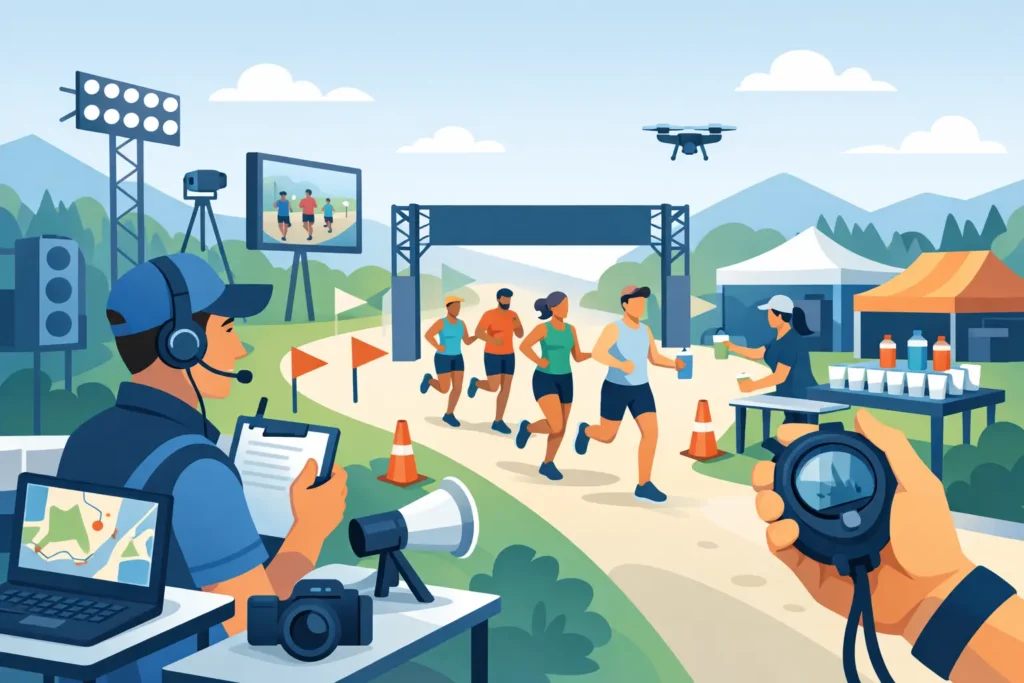
A race can look simple from the outside: a start line, a finish line, a course, and a crowd. But strong race event production is what turns that outline into an experience people trust, enjoy, and want to return to next year. When organizers underestimate production, the weak spots show up fast – in delayed starts, confused participants, volunteer gaps, course issues, sponsor frustration, and a finish area that feels more chaotic than celebratory.
For organizations planning a 5K, charity run, road race series, or multi-activity community event, production is not just the last phase before event day. It is the framework that supports every decision from concept to teardown. The quality of that framework determines whether the event feels controlled, welcoming, and worth repeating.
What race event production actually covers
Race event production is often mistaken for logistics alone. Logistics matter, but production is broader. It includes how the event is designed, how people move through it, how information is communicated, how vendors and volunteers are directed, and how the day stays on track when conditions change.
That means the work starts well before cones are placed or tents are installed. It begins with defining the event’s purpose, participant expectations, operational requirements, and risk profile. A fundraising race has different priorities than a brand activation run. A municipal community race has different stakeholder needs than a competitive regional event. Good production accounts for those differences instead of forcing every race into the same template.
It also bridges two priorities that sometimes compete with each other: operational control and participant experience. You need a course that can be safely staffed and managed. You also need an arrival, start, route, and finish that feel intuitive and energizing. If one side wins at the expense of the other, the event usually suffers.
Why race event production fails
Most race issues are not caused by one dramatic mistake. They come from small planning gaps that compound on event day.
A registration area may be technically functional but placed too close to a busy crossing point, creating congestion before the race even begins. Volunteer roles may be filled, but without clear reporting lines or task-specific briefings, those volunteers cannot respond consistently when questions or problems arise. A course may be approved on paper, but if signage, barricade placement, and public communication are not aligned, runners and spectators experience confusion anyway.
This is where experienced production support matters. It is not only about building a plan. It is about pressure-testing that plan under real conditions. Weather shifts. Vendors arrive late. A road closure runs behind schedule. A key volunteer does not show. The event still has to move forward without exposing participants, staff, or the client brand to unnecessary risk.
The planning decisions that shape the entire event
The strongest race events are usually decided in the early planning stage, long before event week. That is when the team should settle the event footprint, participant flow, staffing model, course support strategy, and site priorities.
Course design is one of the clearest examples. The fastest route is not always the best route. A scenic course may create crowding at narrow points. A downtown course may be attractive for sponsors and spectators but difficult for traffic management and emergency access. A compact event footprint can reduce operational strain, but it may also limit the energy and visibility that help a race feel significant.
Those trade-offs do not have one universal answer. They depend on the race goals, the venue, municipal requirements, expected attendance, and the level of production support available. What matters is making those decisions deliberately, not reactively.
The same is true for the start and finish areas. Organizers often focus on the course itself, but the participant impression is formed just as strongly by what happens before and after the race. Arrival, check-in, wayfinding, emcee timing, hydration access, medical visibility, awards setup, and sponsor presence all shape whether the event feels polished or improvised.
Production is also audience design
A race is not only for runners. It is also experienced by sponsors, families, volunteers, municipal partners, and community members who may never cross the start line.
That broader audience matters because race success is measured in more than finish times. Sponsors want visibility that feels integrated rather than forced. Municipal partners want confidence that public impact is being managed responsibly. Participants want clarity and momentum. Spectators want to know where to go and what is happening. Volunteers want enough structure to be helpful without feeling abandoned.
This is why race event production should be treated as experience design as much as operations. The signage plan affects stress levels. The sound plan affects energy and announcements. The layout affects crowd movement and sponsor value. The volunteer plan affects how supported people feel when they need help.
A well-run event feels easy to attendees because the complexity has been managed behind the scenes. That ease is not accidental.
The operational backbone that organizers often need help with
Internal teams are often strong at promotion, fundraising, community engagement, or stakeholder management. Where they get stretched is in operational depth.
Race production involves permitting coordination, site mapping, vendor sequencing, staffing plans, load-in and load-out timing, equipment placement, safety review, contingency planning, and live problem-solving. Any one of those pieces can affect the rest. If the stage is placed incorrectly, it may interfere with participant flow. If sanitation is underestimated, the finish area experience drops quickly. If vendor arrivals are not timed correctly, setup windows tighten and pressure builds before the public even arrives.
That interdependence is why a race should not be managed as a collection of separate tasks. It needs centralized oversight. Someone has to understand the full picture, make decisions in sequence, and keep each moving part aligned with the event goals.
For many organizations, that is the moment when outside production support becomes most valuable. A professional production partner does not just add labor. They add structure, foresight, and accountability.
How professional race event production protects the brand
Every public event reflects on the organization behind it. That is especially true for nonprofit races, civic events, and branded community runs where trust and reputation matter as much as attendance.
If participants encounter confusion, safety concerns, poor communication, or visible disorganization, they rarely separate those issues from the host organization. The race becomes part of the brand story, whether that story is positive or not.
Professional production protects that reputation by reducing preventable friction. It creates a clearer staff structure, tighter communication, better participant guidance, and stronger vendor coordination. It also helps clients make smarter decisions about where to invest. Not every race needs the same scale of infrastructure, but every race benefits from knowing which elements are essential and which are optional.
That distinction matters for budget control. Overspending in the wrong places can drain resources without improving the experience. Underspending on key operational elements can create larger costs later, whether through participant dissatisfaction, staff strain, or event-day fixes that could have been avoided.
What to look for in a race production partner
Not every event team is built for race work. A partner may be skilled in galas, festivals, or corporate events and still lack the field-tested discipline race environments require.
The right partner should understand participant movement, course-related operations, volunteer coordination, public-facing event flow, and live site management. They should also be comfortable balancing client goals with practical constraints. Sometimes the best answer is not the most ambitious one. It is the one that can be executed cleanly with the staff, site, and budget available.
That is especially relevant for events in busy municipal settings or variable-weather regions such as the Northeast, where site conditions and public coordination can shift quickly. Planning has to be realistic, not theoretical.
A capable production partner should also know how to scale. Some clients need full event creation from the ground up. Others need to refresh an existing race that has outgrown internal capacity or become operationally inconsistent. Both situations require experience, but they do not require the same approach.
At Calibrate Event Production, that distinction is central to how race support is delivered. The goal is not to overcomplicate an event. It is to bring the right level of planning, structure, and execution so the client can deliver a race that feels organized, participant-centered, and ready for repeat growth.
A race people remember for the right reasons
Participants may remember the medal, the photos, or the final sprint. Organizers remember the timeline, the staffing chart, the radio calls, and the hundred decisions that kept the day moving. Both perspectives matter.
The best race events succeed because they respect both. They create a meaningful public experience while holding up operationally under real-world pressure. When production is handled with care, the event feels confident from start to finish – and that confidence is what earns repeat participation, sponsor trust, and long-term value.
If you are planning a race, the goal is not just to get everyone across the finish line. It is to build an event that works as well behind the scenes as it looks out front.