
A great event rarely feels complicated to the people attending it. That is usually the clearest sign that a lot of complicated work happened behind the scenes. When organizations start asking what an event production agency does, they are often already feeling the pressure – too many vendors, too many timelines, too many decisions, and too much riding on one live experience.
An event production agency exists to bring structure, oversight, and execution to that complexity. In some cases, that means building an event from the ground up. In others, it means stepping into an existing event that has outgrown internal capacity and needs stronger systems, sharper design, and tighter operational control. The work is part strategy, part logistics, and part field management. More than anything, it is about making sure the event works for the people attending it and for the organization behind it.
What an event production agency is responsible for
The short answer is this: an event production agency plans, coordinates, and executes the many moving parts required to deliver a successful live event.
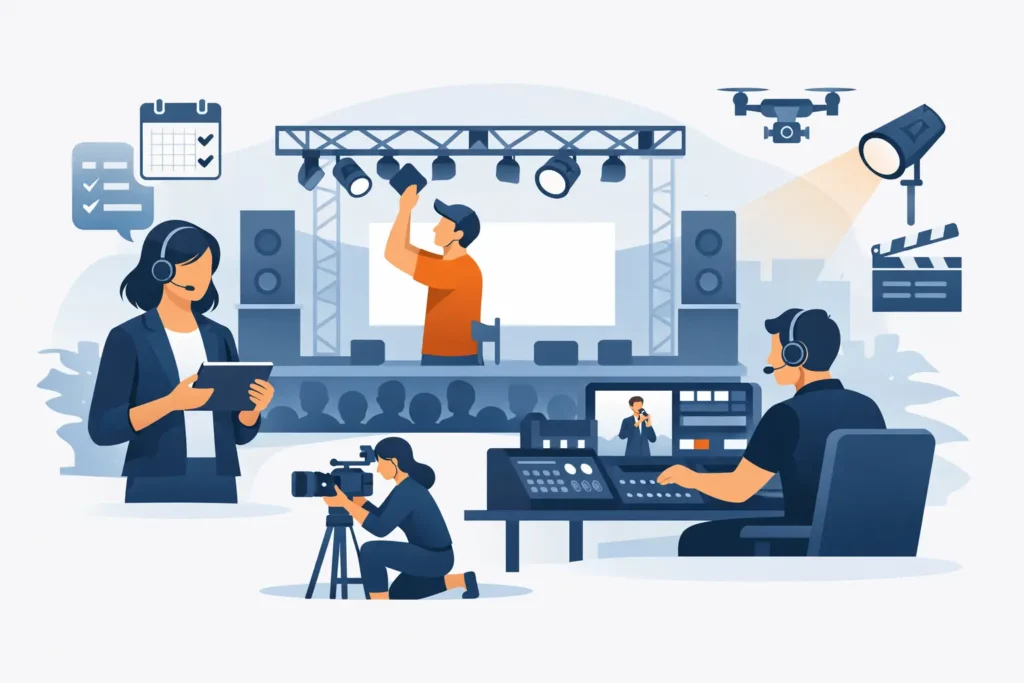
That sounds broad because it is. Depending on the event, the agency may help define the concept, map the participant journey, manage budgets, build timelines, secure vendors, oversee permitting, coordinate staffing, direct load-in and load-out, troubleshoot onsite issues, and keep the client team informed from start to finish.
For a nonprofit walk, a community festival, a road race, a municipal celebration, or a branded public event, those responsibilities can quickly expand. Registration, signage, volunteer flow, route logistics, sponsor integration, safety planning, staging, power, communications, and audience experience all need to align. If one area slips, the attendee may not know exactly what went wrong, but they will feel it.
That is why strong event production is not just about making an event look polished. It is about creating an environment where operations support the experience instead of competing with it.
Why organizations hire an event production agency
Many organizations do not need help because they lack capable people. They need help because live events demand a specific kind of coordination that stretches internal teams beyond what is reasonable.
A marketing team may know how to promote an event but not how to manage site operations for thousands of attendees. A nonprofit may have a clear mission and strong community support but limited capacity to coordinate vendors, volunteers, and day-of logistics. A municipality may understand stakeholder management but need a production partner who can translate public goals into a workable event plan.
This is where an event production agency adds value. It gives decision-makers a partner who can see the whole picture while also managing the details. That matters most when the event has public visibility, multiple constituencies, or no margin for confusion.
There is also a practical financial angle. Hiring outside support can look like an added expense, but running a poorly coordinated event is expensive too. Delays, vendor gaps, staffing issues, unclear communications, and participant frustration all carry real costs. Sometimes those costs show up in the budget. Sometimes they show up in reputation.
The difference between planning and production
One of the biggest misconceptions in this space is that planning and production are interchangeable. They overlap, but they are not the same.
Planning is about shaping the event before it happens. It includes scope, scheduling, vendor coordination, budget alignment, experience design, and decision-making. Production is about translating that plan into real-world execution. It is the operational discipline required to make sure the event happens as intended, under actual conditions, with real constraints and live variables.
A strong partner handles both. If a plan looks good on paper but cannot function onsite, the planning was incomplete. If the onsite team is forced to improvise because key operational questions were never resolved, the event becomes reactive instead of controlled.
That is why experienced agencies focus on continuity from concept through execution. The handoff between strategy and onsite delivery is often where problems start. When one team develops the plan and another inherits the pressure, details get lost. A full-service model reduces that risk.
What good event production looks like in practice
Good event production is rarely flashy from the inside. It is disciplined. Timelines are realistic. Roles are clear. Vendor expectations are documented. Site plans are grounded in actual traffic flow, not wishful thinking. The attendee experience has been considered at every touchpoint, from arrival and wayfinding to comfort, pacing, and departure.
It also means thinking ahead. What happens if weather changes? What happens if participant counts increase? What happens if a vendor is late, a speaker runs over, a route needs adjustment, or a volunteer check-in area backs up? A seasoned agency does not wait for those questions to become emergencies.
This is especially important for events with many stakeholders. A race organizer may need participant satisfaction, sponsor visibility, municipal compliance, and volunteer coordination all working at once. A brand activation may need visual impact without operational disruption. A civic event may need to balance public access, safety, and efficient site management. The right solution depends on the event, but the standard is the same: clear systems, strong oversight, and fast decision-making.
When to bring in an event production agency
Sometimes the right time is obvious. A new event is launching, an existing event is growing, or the internal team is already stretched thin. In other cases, the signals are more subtle.
If planning meetings keep circling back to unresolved logistics, outside support may be needed. If staff members are carrying event responsibilities on top of full-time jobs, that is a risk. If vendor management feels fragmented, if the attendee experience feels inconsistent, or if the event depends too heavily on last-minute problem solving, the operation likely needs more structure.
An agency can also be valuable when an event needs repositioning rather than rescue. Some events are functional but forgettable. Attendance may be stable, but the experience lacks energy, flow, or clarity. In that situation, the goal is not simply to keep the event running. It is to improve it.
That can mean refining the concept, reworking the site layout, improving participant communications, enhancing sponsor integration, or tightening onsite management so the event feels more intentional from beginning to end.
How to evaluate an event production agency
Not every agency solves the same problem. Some are strongest in creative direction. Others are built for logistics and field execution. Some do excellent work on corporate meetings but are less suited for outdoor public events with complex stakeholder demands.
The right fit depends on what your event actually requires.
Look for an agency that can explain how it manages both the visible and invisible parts of production. Creative ideas matter, but so do site plans, staffing models, communications protocols, contingency planning, and vendor oversight. Ask how the team handles operational pressure. Ask who is onsite. Ask how they define success beyond attendance numbers.
Experience also matters in a practical sense. An agency that has worked across formats and conditions is more likely to anticipate issues early and solve them efficiently. That does not mean the biggest firm is automatically the best choice. It means the team should bring judgment, process, and accountability.
For organizations in New England managing races, festivals, nonprofit events, or public-facing activations, regional familiarity can help as well. Venue realities, municipal coordination, seasonal conditions, and audience expectations all affect execution. A partner with both local understanding and broader operational range can be especially effective.
The best agency relationship is collaborative
Hiring an agency does not mean handing over your event and stepping away. The best outcomes come from partnership. The client brings goals, audience knowledge, stakeholder context, and brand priorities. The agency brings production expertise, systems, and delivery discipline.
That collaboration works best when expectations are clear early. What decisions stay with the client? What authority does the agency hold onsite? What does success look like for attendees, sponsors, staff, and community partners? Those conversations create the framework for stronger execution later.
At its best, event production gives organizations room to focus on purpose instead of chasing problems. That is why companies like Calibrate Event Production are brought in not just to manage details, but to elevate the entire experience with planning rigor and operational control.
A well-produced event does more than stay on schedule. It builds confidence. It reflects well on the organization behind it. And it leaves participants with the sense that everything worked exactly the way it should.